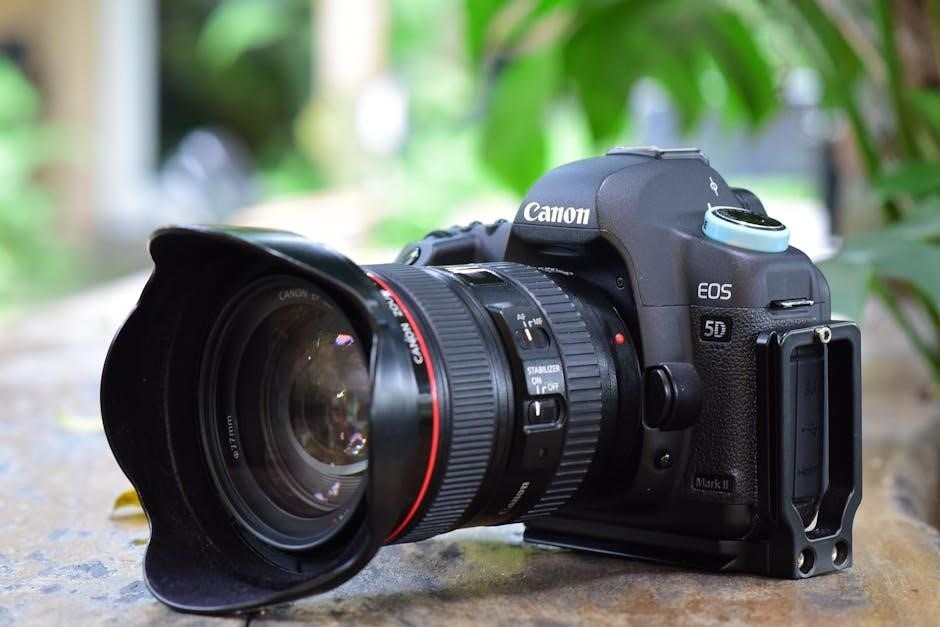
Canon EOS 5D Mark III User Manual: A Comprehensive Guide
This comprehensive guide details the Canon EOS 5D Mark III, covering its features, operations, and troubleshooting – a 408-page resource available online as a PDF.
Welcome to the world of the Canon EOS 5D Mark III! This powerful full-frame DSLR, even years after its release, remains a favorite among professionals and enthusiasts. This manual serves as your complete companion, guiding you through every aspect of the camera.
Whether you’re a seasoned photographer or just starting, understanding your 5D Mark III is key to unlocking its full potential. This guide will cover everything from initial setup and basic operations to advanced features and troubleshooting. Download the official 408-page PDF manual for detailed instructions and explore online forums for community support.
Key Features and Specifications
The Canon EOS 5D Mark III boasts a remarkable feature set. It features a 22.3MP full-frame CMOS sensor, delivering exceptional image quality and low-light performance. Capture stunning detail with its 61-point High-Density Reticular Autofocus system.
Record Full HD video at multiple frame rates, and benefit from advanced features like High-Speed Continuous Shooting. The camera’s robust build and intuitive controls make it ideal for diverse photographic applications. The downloadable manual details all specifications, including ISO range, shutter speed, and connectivity options.
Camera Setup and Basic Operations
Initial setup involves menu configuration, understanding shooting modes, and navigating the Canon 5D Mark III’s menu system – all detailed within the comprehensive user manual.
Initial Setup: Menu Configuration
The initial setup of your Canon EOS 5D Mark III centers around meticulous menu configuration. This involves customizing settings to align with your shooting preferences and needs. The user manual guides you through each menu tab, explaining options for image quality, autofocus, metering, and more.
Pay close attention to settings like date/time, file naming, and image review. Properly configuring these foundational elements ensures a smooth and efficient workflow. The manual emphasizes understanding each setting’s impact on your final images, allowing for personalized control over the camera’s behavior. Don’t hesitate to explore and experiment!
Understanding the Shooting Modes
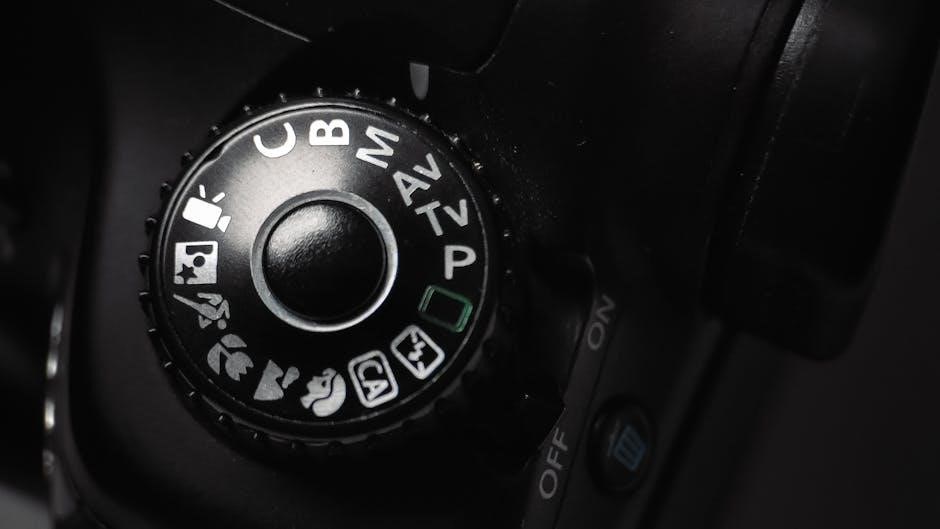
The Canon EOS 5D Mark III offers a versatile array of shooting modes, catering to diverse photographic scenarios. The user manual thoroughly explains each mode – Program (P), Aperture Priority (Av), Shutter Priority (Tv), and Manual (M) – detailing how they control exposure.
Beyond these core modes, explore Scene Intelligent Auto, allowing the camera to optimize settings, and the creative modes for specific effects. Understanding when to utilize each mode is crucial for achieving desired results. The manual provides practical examples, empowering you to confidently select the appropriate setting for any shooting situation.
Navigating the Canon 5D Mark III Menu System
The Canon 5D Mark III’s menu system, while extensive, becomes manageable with a structured approach; The user manual dedicates significant attention to its organization, dividing settings into intuitive tabs – Shooting, AF, Exposure, Picture Quality, and more.
Learn to efficiently locate and adjust key parameters like image quality, autofocus behavior, and custom functions. The manual’s detailed explanations and visual aids demystify each option, enabling you to personalize the camera to your preferences. Mastering menu navigation unlocks the full potential of the 5D Mark III.
Mastering Exposure and Focus
Achieve optimal results by understanding aperture, shutter speed, ISO, and autofocus modes – crucial elements detailed within the Canon EOS 5D Mark III manual.
Aperture, Shutter Speed, and ISO Explained
Understanding the exposure triangle – aperture, shutter speed, and ISO – is fundamental to photography with the Canon EOS 5D Mark III. Aperture controls depth of field, influencing how much of the image is in focus. Shutter speed dictates motion blur or freezing action, while ISO determines the camera’s sensitivity to light;
The 5D Mark III manual thoroughly explains how these settings interact, allowing photographers to creatively control exposure and image quality. Mastering these concepts enables precise control over brightness, depth of field, and the appearance of motion, ultimately leading to stunning photographs. Experimentation and practice, guided by the manual, are key.
Autofocus Modes and Selection
The Canon EOS 5D Mark III offers a sophisticated autofocus (AF) system with various modes tailored to different shooting scenarios. These include One Shot for static subjects, AI Servo for tracking moving subjects, and AI Focus for automatically switching between the two. The manual details selecting AF point selection methods – single-point, zone, and automatic – for precise focusing.
Understanding each mode’s strengths and weaknesses, as outlined in the user manual, is crucial for capturing sharp images. Customizing AF settings, like tracking sensitivity and acceleration/deceleration, further refines performance. Proper AF mode selection ensures consistently focused results.
Metering Modes for Accurate Exposure
The Canon EOS 5D Mark III provides several metering modes to achieve accurate exposure in diverse lighting conditions. Evaluative metering, the default, analyzes the entire scene. Partial metering focuses on a small area, ideal for backlit subjects. Center-weighted average metering prioritizes the center of the frame. Spot metering measures a very small point, offering precise control.
The user manual explains how each mode impacts exposure, guiding users to select the optimal setting for specific scenes. Understanding these modes, and utilizing exposure compensation, ensures properly exposed photographs consistently, even in challenging lighting.
Image Quality and Settings
Explore RAW versus JPEG options, Picture Style settings for customized looks, and white balance adjustments for accurate colors within the 5D Mark III manual.
RAW vs. JPEG: Choosing Your File Format
Understanding the difference between RAW and JPEG is crucial for image quality. RAW files capture all image data, offering maximum editing flexibility, but require post-processing. JPEG files are compressed, resulting in smaller file sizes and immediate usability, though with some data loss.
The Canon EOS 5D Mark III manual details how RAW provides superior dynamic range and color accuracy, ideal for professional workflows. JPEG is suitable for quick sharing or when editing isn’t a priority. Consider your editing needs and storage capacity when selecting a format;
Picture Style Settings for Custom Looks
Canon’s Picture Style settings allow you to customize the look of your images directly within the camera. Options like Standard, Portrait, Landscape, Neutral, Faithful, and Monochrome offer pre-defined tonal curves and color adjustments.
The 5D Mark III manual explains how to fine-tune these styles or create custom ones, adjusting sharpness, contrast, color saturation, and tone. Experimenting with Picture Styles lets you achieve desired aesthetics without extensive post-processing, streamlining your workflow and delivering consistent results straight from the camera.
White Balance Adjustment for Accurate Colors
Achieving accurate colors requires proper white balance adjustment. The Canon EOS 5D Mark III offers numerous presets – Auto, Daylight, Cloudy, Shade, Tungsten, Fluorescent, Flash, and Custom – to match the lighting conditions.
The user manual details how to use the Custom white balance, allowing you to manually set a reference point for color accuracy. Incorrect white balance results in color casts; mastering this setting ensures natural-looking images, crucial for professional results and faithful reproduction of scenes.

Advanced Features and Functions
Explore high-speed continuous shooting, Live View capabilities, and the built-in flash features detailed within the 408-page Canon EOS 5D Mark III manual.

High-Speed Continuous Shooting
The Canon EOS 5D Mark III excels in capturing fast-action sequences, offering high-speed continuous shooting modes for various photographic needs. This feature, thoroughly explained in the comprehensive 408-page user manual, allows photographers to freeze motion effectively.
Understanding the different drive modes – single shooting, continuous shooting, and self-timer – is crucial. The manual details how to adjust settings for optimal performance, including shutter speed and autofocus tracking.
It also covers considerations for memory card speed and capacity when utilizing these modes, ensuring seamless capture of extended bursts. Mastering this capability unlocks dynamic imagery.
Live View Shooting and Features
The Canon EOS 5D Mark III’s Live View mode provides a unique shooting experience, detailed within the extensive 408-page user manual. This allows image composition and review directly on the camera’s LCD screen, offering precise control and flexibility.
The manual explains features like magnified view for critical focusing, grid display for alignment, and histogram display for exposure assessment.
It also covers the use of autofocus in Live View, including face detection and tracking capabilities. Understanding these features enhances creative possibilities and ensures sharp, well-composed images;
Using the Built-in Flash
The Canon EOS 5D Mark III’s built-in flash, thoroughly explained in the 408-page manual, offers a convenient lighting solution for various shooting scenarios. The manual details flash modes, including auto, manual, and red-eye reduction, allowing photographers to control light output.
It covers flash exposure compensation and synchronization with shutter speed, ensuring proper illumination.
Furthermore, the guide explains utilizing the flash as a fill light to balance exposure and reduce harsh shadows, enhancing image quality and creative control.
Connectivity and Data Transfer
The user manual details connecting the Canon EOS 5D Mark III to computers via USB and wireless options, alongside Canon’s EOS Utility software.
Connecting to a Computer via USB
Establishing a USB connection allows for seamless data transfer from your Canon EOS 5D Mark III to your computer. The user manual provides detailed instructions on connecting the camera using a USB cable, ensuring proper recognition by your operating system.
It outlines the necessary steps for transferring images and videos, including selecting the appropriate transfer mode. Furthermore, the manual explains how to utilize Canon’s EOS Utility software alongside the USB connection for advanced features like remote shooting and image browsing directly on your computer screen.
Troubleshooting tips are also included to address potential connectivity issues, ensuring a smooth and efficient workflow for managing your photographic content.
Wireless File Transfer Options
The Canon EOS 5D Mark III, while not natively equipped with Wi-Fi, offers wireless file transfer solutions through compatible accessories. The user manual details utilizing Canon’s WFT-E5A Wireless File Transmitter, enabling connection to wireless networks for image sharing and remote control.
Instructions cover setting up the WFT-E5A, connecting to a Wi-Fi network, and transferring files to computers or smartphones. The manual also explains utilizing FTP transfer for uploading images directly to web servers.
Troubleshooting sections address common wireless connectivity problems, ensuring a reliable workflow for remote image delivery.
Using Canon’s EOS Utility Software
Canon’s EOS Utility software, downloadable from Canon’s support website, provides extensive control over the 5D Mark III from a computer. The user manual thoroughly explains its features, including image browsing, downloading, and organization.
Detailed instructions cover remote live view control, allowing photographers to compose and trigger shots directly from the computer.
The software also facilitates camera settings adjustments, firmware updates, and image editing workflows, enhancing post-processing capabilities and streamlining image management.

Troubleshooting Common Issues
This section addresses autofocus problems, image quality concerns, and error messages encountered with the Canon EOS 5D Mark III, offering practical solutions.
Addressing Autofocus Problems
If experiencing autofocus issues with your Canon EOS 5D Mark III, first verify the lens is properly attached and compatible. Ensure autofocus settings are appropriate for your subject – selecting the correct AF mode (One Shot, AI Servo, AI Focus) is crucial.
Check for obstructions hindering the autofocus system, and confirm sufficient lighting conditions. Clean the autofocus sensor and lens contacts. If problems persist, try a different lens or consider recalibrating the autofocus system via custom functions within the camera’s menu. Refer to the official manual for detailed instructions on these procedures.
Resolving Image Quality Concerns
Addressing image quality issues on the Canon EOS 5D Mark III begins with verifying your chosen file format – RAW offers greater editing flexibility than JPEG. Confirm Picture Style settings align with your desired aesthetic; experiment with presets or create custom profiles.
Ensure correct white balance is selected to avoid color casts. Check for lens flare or dust on the sensor. If noise is excessive, lower the ISO or utilize noise reduction features. Review sharpness settings and consider lens calibration for optimal results, consulting the full manual for guidance.
Dealing with Error Messages
Encountering error messages on your Canon EOS 5D Mark III requires careful attention. Consult the comprehensive user manual (available as a 408-page PDF download) for specific code explanations. Common errors relate to the card, battery, or lens connection – ensure these are properly seated and functional.
Attempt resetting the camera to factory defaults. If the issue persists, note the exact error code and search Canon’s support website or online forums for solutions. Documenting the circumstances surrounding the error aids troubleshooting.

Resources and Further Learning
Expand your knowledge with the official Canon manual (PDF), online forums, and Canon’s support website for drivers and detailed assistance;
Downloading the Official Canon Manual (PDF)
Access the complete 408-page Canon EOS 5D Mark III instruction manual as a downloadable PDF file, readily available from Canon’s official website. This resource, approximately 26.10 MB in size, provides in-depth guidance on all camera functions and features.
You can find the manual through Canon USA’s website, specifically in the Brochures and Manuals section for the EOS 5D Mark III.
Be aware that some downloaded versions may contain watermarks; however, these won’t appear when viewing the manual in Acrobat Reader, only during printing.
Online Forums and Communities
Expand your knowledge and connect with fellow Canon EOS 5D Mark III users through dedicated online forums and communities. These platforms offer a valuable space to ask questions, share experiences, and troubleshoot issues collaboratively.
Benefit from the collective wisdom of experienced photographers who can provide insights, tips, and solutions to common challenges.
Engage in discussions about specific features, techniques, and best practices for maximizing your camera’s potential.
Canon Support Website and Drivers
Access official resources and ensure optimal performance by visiting the Canon Support website for your EOS 5D Mark III. Here, you’ll find the latest firmware updates, essential drivers for seamless computer connectivity, and a comprehensive library of downloadable manuals.
Regularly checking for updates guarantees compatibility and access to new features.
Canon’s support portal provides troubleshooting assistance and answers to frequently asked questions, helping you resolve any technical issues efficiently.